
Liquidnitro Games announced that Cedrick Collomb, most recently CTO of Tencent Games Global and pre 2026-7-22 14:29:32 Author: hackernoon.com(查看原文) 阅读量:5 收藏
Liquidnitro Games announced that Cedrick Collomb, most recently CTO of Tencent Games Global and previously CTO of EA Mobile, has joined as Chief Technology Officer. The appointment lands months after the company's $19.1 million Series A, which took total funding to $24.3 million. Liquidnitro has grown past 140 developers in two years and expects to exceed 200 by the close of the fiscal year, a hiring posture that runs directly against the industry's prevailing direction. Collomb takes ownership of long-term technology strategy, centered on Geoplay, the company's agentic AI operating platform, alongside its Nitro Forge, Nitro Brain and Nitro Blocks systems.
The Market Analysis: Growth Without New Players Changes What a Studio Sells
The institutional context for this hire is a games market that has structurally changed how it grows. Newzoo's latest forecast puts 2025 global games revenue at $197 billion, up 7.5 percent, a genuine recovery after near-flat readings in 2023 and 2024 and a contraction in 2022. But the composition of that growth is the tell. Newzoo's own analysts attribute the rebound to players spending more deeply inside games and ecosystems they already value, not to an expanding player base. Revenue is compounding through retention, live operations and monetization depth, which means the scarce commercial skill is no longer shipping a game. It is keeping one alive and improving for years.
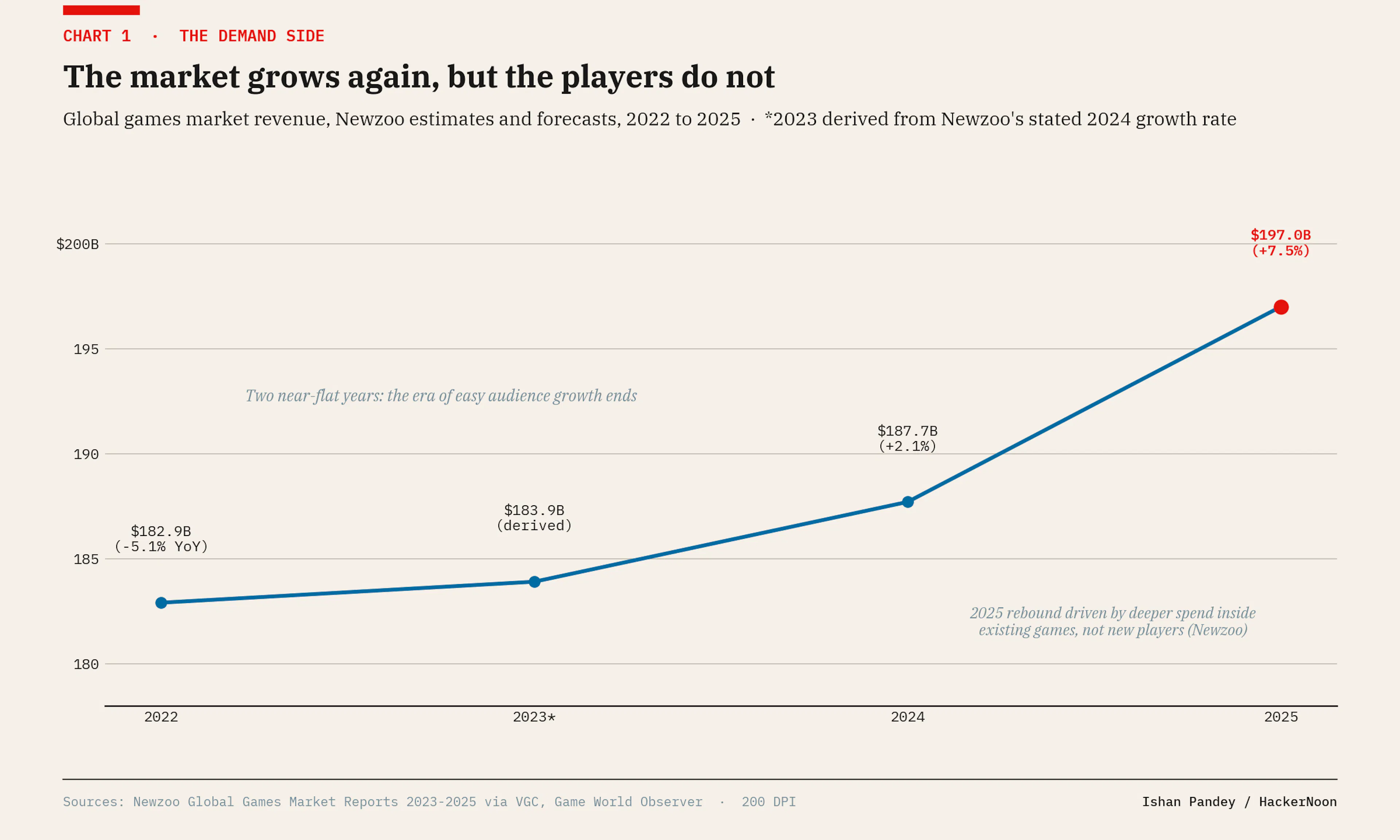 Global games market revenue, 2022 to 2025. Source: Newzoo.
The cost side is where the old model visibly failed. Crowd-sourced industry tracking recorded roughly 8,500 layoffs in 2022, 10,500 in 2023, a peak of 14,600 in 2024, and an understated 5,900 or more in 2025, a figure that excludes part of Microsoft's July 2025 cuts. Call it roughly 39,500 tracked job losses in four years, with GDC's 2025 survey finding 11 percent of polled developers personally laid off. The industry scaled headcount into a market that stopped rewarding scale. Every publisher now faces the same equation: more output quality per developer, or fewer developers. Liquidnitro's entire pitch, and this hire, sit inside that equation.
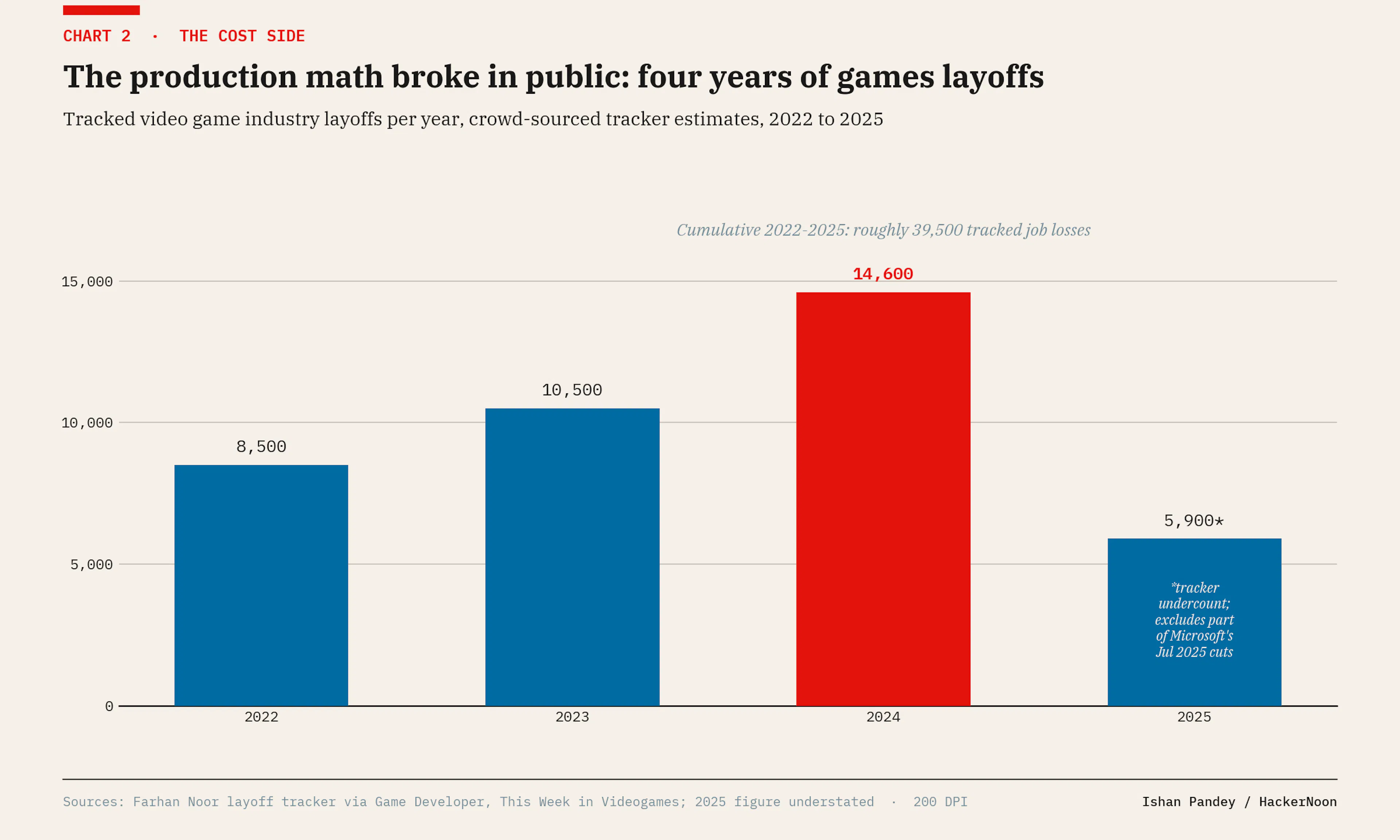 Tracked games industry layoffs per year, 2022 to 2025.
What Collomb's CV Actually Prices In
Executive appointments are information. The right way to read this one is to ask what problems Collomb has already solved that Liquidnitro is about to encounter. The career arc covers the full production stack across nearly three decades: console-era engineering at Sony Computer Entertainment, AAA franchise production at LucasArts, mobile free-to-play live economies at Kabam, then the platform-scale problems, as CTO of EA Mobile and subsequently CTO of Tencent Games Global, with detours through AMD and Pearson that added silicon-level and large-system perspective. That last decade matters most for this role. Tencent and EA Mobile are the two organizations on Earth that have most thoroughly industrialized live-service operations across hundreds of titles and markets, and the CTO seat at both is fundamentally a platform job: build shared technology that makes every team above it faster. That is precisely the job description at Liquidnitro, shrunk from tens of thousands of developers to two hundred, which is arguably the point. Platform leverage that needed Tencent's scale to justify a decade ago is now, with agentic AI, plausibly buildable at studio scale.
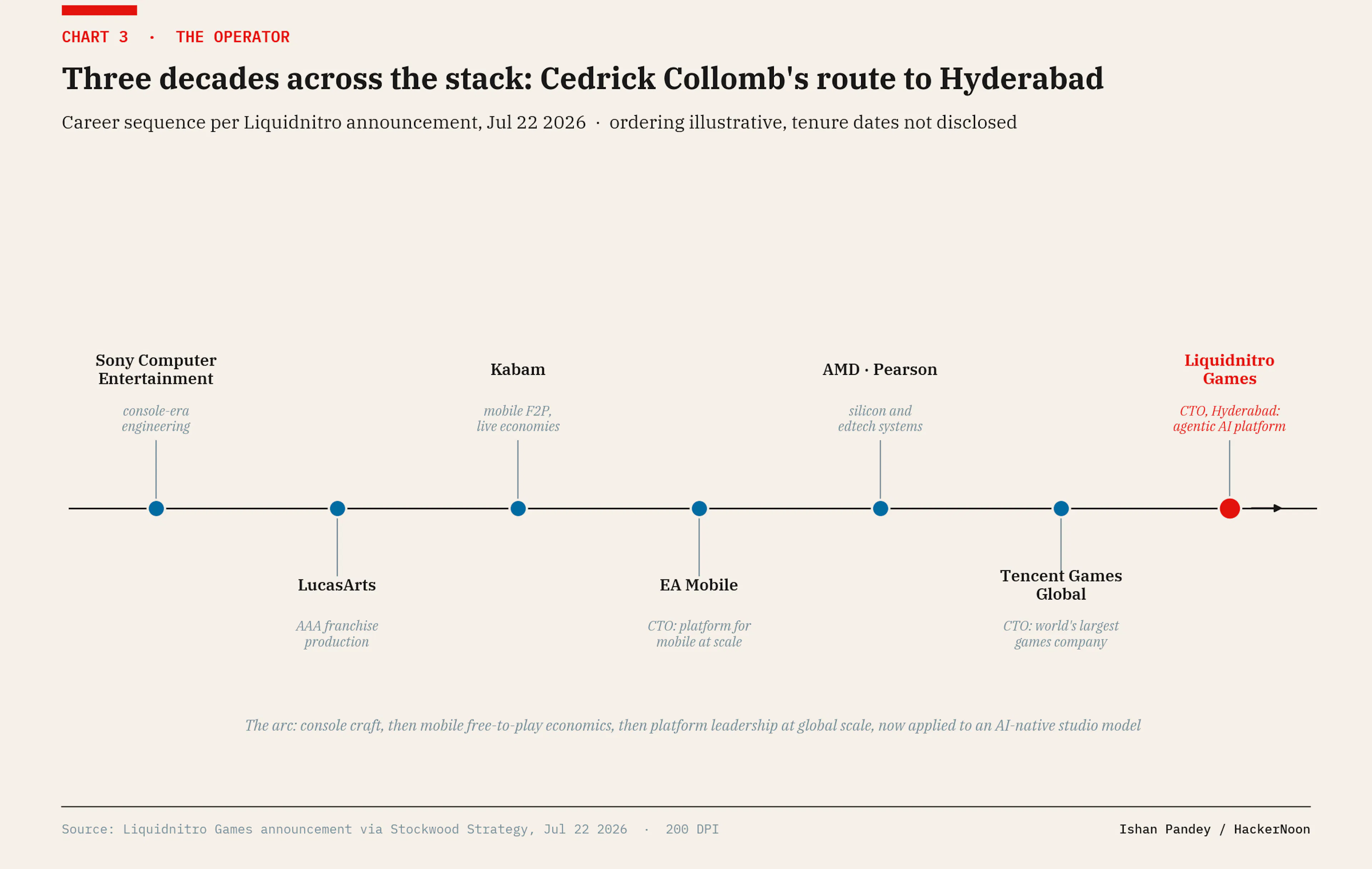 Collomb's career sequence
There is also a market-signal reading. Senior operators tend to move toward where they believe the next production model will be proven. A Tencent Games Global CTO choosing a Hyderabad platform studio over another megacap seat is a data point about India's maturation as a production hub, not just a consumption market, and it will be read that way by every publisher evaluating co-development partners in the region.
Liquidnitro's platform claims deserve precise unpacking, because the AI-in-games market is currently flooded with two lower-value propositions: point tools that generate assets, and analytics dashboards that describe problems after they happen. The company is positioning Geoplay as something structurally different, an agentic operating layer that connects creative production, live operations and player intelligence into one self-learning loop, with Nitro Forge, Nitro Brain and Nitro Blocks as the component systems. The stated design philosophy, AI as an amplifier for expert teams rather than a replacement for them, is partly values language, but it is also a commercial filter: it targets publishers who need quality at lower cost, not content farms chasing volume.
The business model wrapped around the platform is the more differentiated claim. Liquidnitro presents itself as a games partner that owns both strategy and execution and commits to measurable outcomes, across zero-to-one production, end-to-end live services, and expansion into India, MENA and Southeast Asia. That is an accountability structure closer to a co-development principal than a services vendor, and it only works economically if the platform genuinely compresses production cost, which is exactly what Collomb was hired to make true. The risk, flagged plainly, is that none of the platform's efficiency claims are yet externally verifiable, and the burden of proof sits with shipped titles and retained live services contracts.
The Asymmetry Is the Opportunity
The expansion map is where the strategy compounds. Niko Partners' 2026 Market Model projects Asia and MENA games revenue rising from $88.9 billion in 2025 to $103.6 billion by 2030, with nearly 2 billion players by decade's end. Inside that, India is the fastest-growing market Niko tracks, crossing 500 million gamers and $1 billion in player spending in 2025, with forecast revenue growth of 12.3 percent annually, while the MENA-3 cluster of Saudi Arabia, the UAE and Egypt compounds at 6.8 percent. The most important single statistic is the asymmetry: India holds roughly 30 percent of the combined region's players and only about 1 percent of its revenue. Markets do not hold that shape forever. A Hyderabad-headquartered studio with global platform technology and cultural proximity to India, MENA and Southeast Asia is positioned on the correct side of that convergence, at exactly the moment global publishers are being forced to look beyond saturated Western audiences.
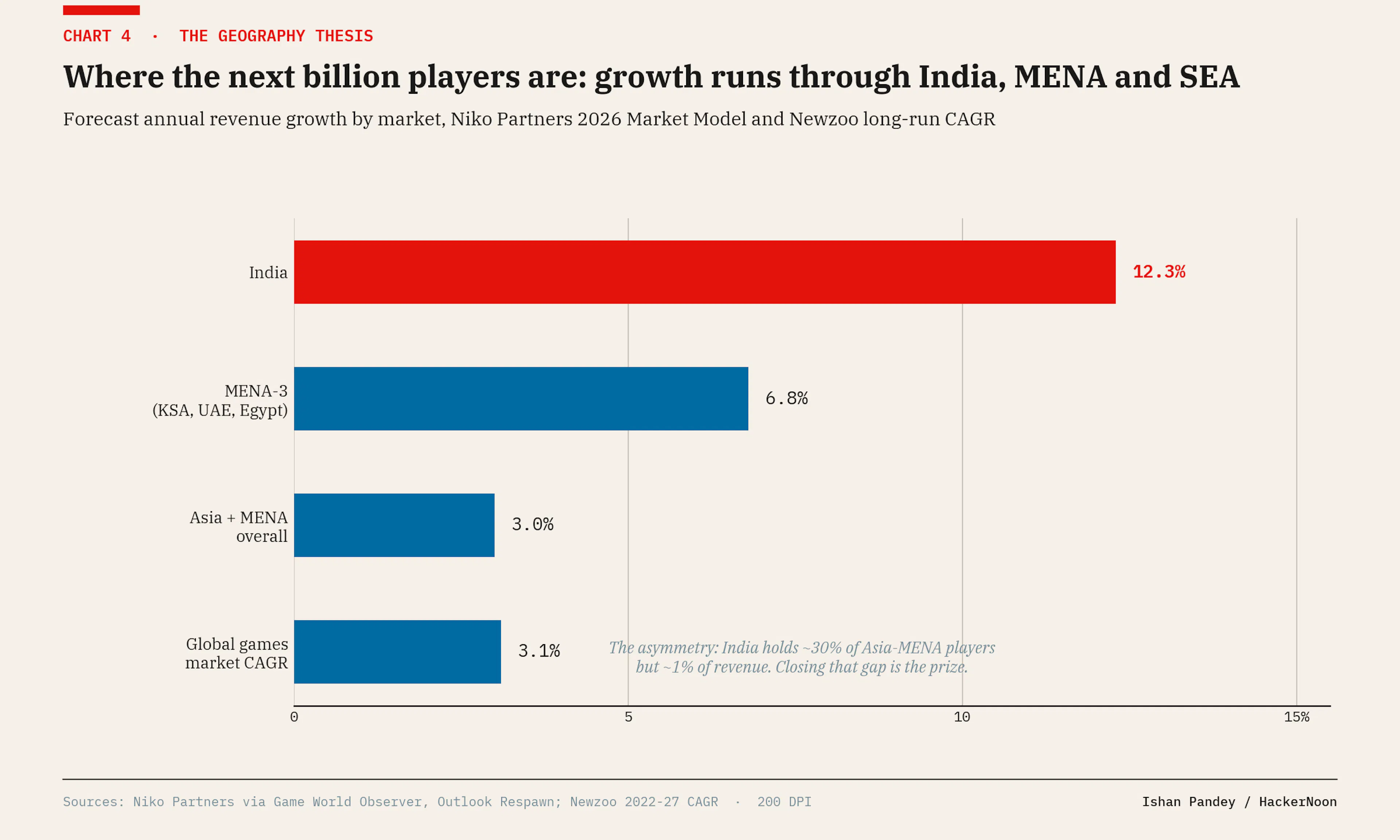 Forecast annual revenue growth by market. India in red.
What Has to Go Right
Four dependencies, in order of difficulty. First, the platform has to produce externally legible efficiency, a shipped title or live service where cost, speed or retention outcomes are demonstrably better than the market baseline, because "AI-powered production" is currently an unpriced claim made by hundreds of companies. Second, the hiring plan has to survive contact with the same cost pressures that produced four years of industry layoffs; growing from 140 to 200 people is only coherent if revenue per developer rises faster than headcount. Third, the accountability model, owning outcomes rather than billing hours, concentrates risk on Liquidnitro's own balance sheet, and one underperforming flagship engagement would test it. Fourth, executive integration itself: platform CTOs from 100,000-person organizations succeed at startups when they build, not when they govern, and the first twelve months of Geoplay's roadmap will show which mode this is.
What to Watch
Three markers over the next eighteen months will show whether this appointment changed the company or just the letterhead. Watch the headcount number first. Liquidnitro has publicly committed to crossing 200 developers by fiscal year end, in an industry that has spent four years cutting. If that number is reached and held into 2027, the platform economics are working. If hiring quietly stalls, that is the earliest visible signal that revenue per developer is not rising the way the model requires.
Watch what Geoplay produces that outsiders can verify. The next publisher engagement, the next title launch, the next live services renewal: any of these arriving with concrete outcomes attached, faster production, stronger retention, a named client extending scope, converts the platform from claim to evidence. Announcements about the platform do not count. Work shipped through it does.
Watch where Collomb spends his first year. Platform CTOs arriving from hundred-thousand-person organizations succeed at this scale when they build and struggle when they govern. A visible Geoplay roadmap, technical hiring under him, and engineering output in shipped work would confirm the operator reading of this hire. A year of keynotes without platform milestones would confirm the other one.
Vested Interest Disclosure: HackerNoon has reviewed the report for quality, but the claims herein belong to the author. All market data is independently sourced and hyperlinked. Do your own research. #DYOR.
如有侵权请联系:admin#unsafe.sh