
Prop crypto trading is now one of the fastest-growing categories around Hyperliquid. Several teams a 2026-7-21 15:54:57 Author: hackernoon.com(查看原文) 阅读量:7 收藏
Prop crypto trading is now one of the fastest-growing categories around Hyperliquid. Several teams are building funded crypto trading programs on top of its infrastructure, while API access allows these accounts to connect with terminals, algorithmic platforms, and automated agents.
The model is familiar to retail traders. A participant pays for an evaluation, follows predefined risk limits, and receives a funded account after passing, while keeping a share of the profits.
For example, a $10,000 account may have a maximum drawdown of $1,000. The trader can use the full crypto trading limit, but the account is closed once losses exceed the threshold.
Hyperliquid provides the markets, order matching, account infrastructure, execution, and settlement. Prop protocols build the evaluation process, risk rules, capital allocation, and payouts on top of this foundation.
From Traditional Prop Firms to Onchain Funded Trading
Funded trading originated in traditional financial markets, where proprietary firms allocated capital to traders under predefined profit targets and risk limits. Retail prop firms later adapted this model by allowing traders to pay for an evaluation and qualify for a funded account.
The same structure expanded into crypto trading. Crypto prop firms began offering evaluations linked to digital asset markets, giving traders access to larger trading limits without requiring them to provide the full nominal capital.
The difference between nominal account size and actual risk allowance becomes clear in a simple comparison.
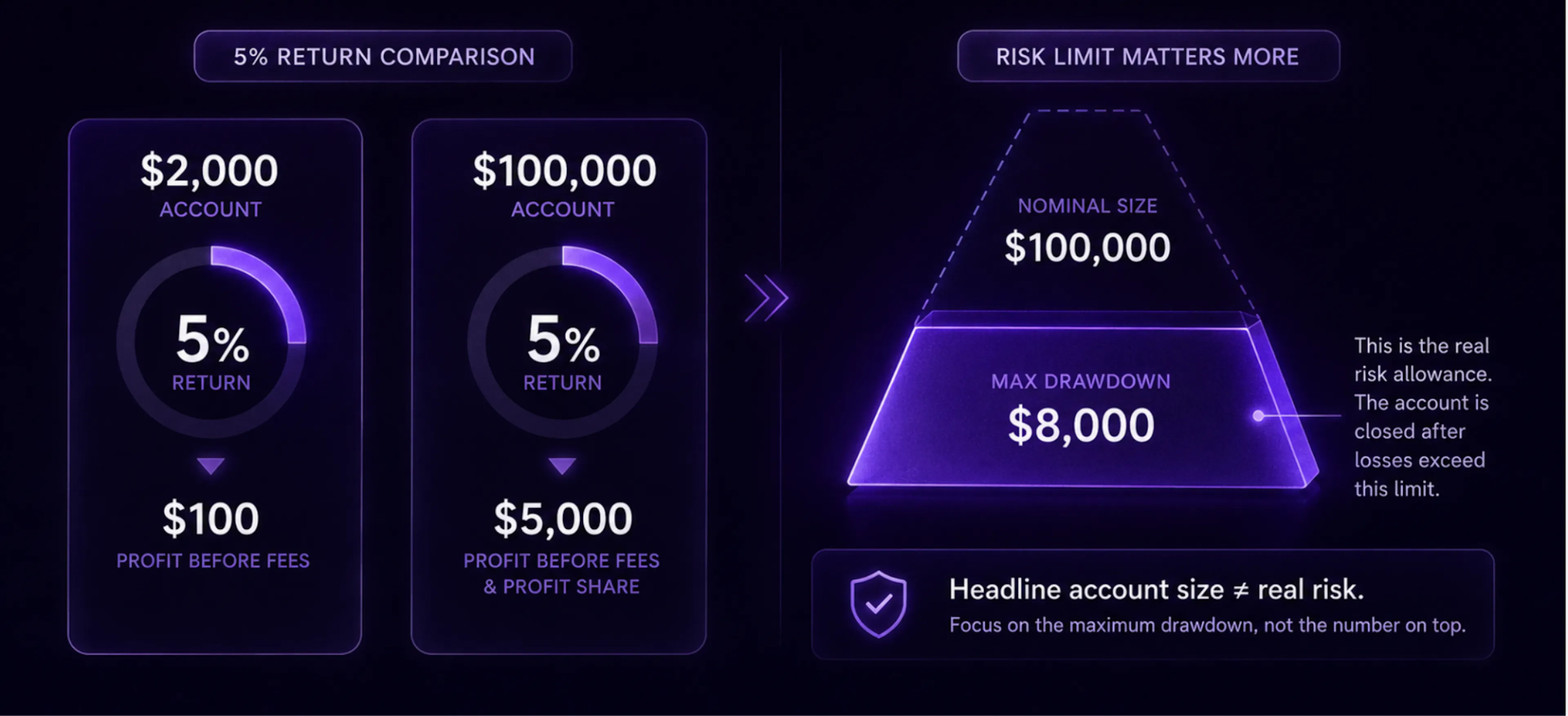
This comparison shows why maximum drawdown matters more than the headline account balance when evaluating a funded crypto trading program.
At the same time, many crypto prop firms continued to operate through closed or simulated environments rather than executing every trade directly on a public market.
The case intensified questions about where orders were executed, how account limits were calculated, and how payouts were funded.
Onchain prop protocols represent the next stage of this development. Instead of keeping execution entirely inside a closed system, they can use public blockchain infrastructure for accounts, trades, settlement, and transfers. This makes more of the trading activity verifiable, although evaluation rules, drawdown calculations, capital allocation, and payout terms still depend on each protocol.
Hyperliquid as the Execution Layer for Onchain Prop Trading
Onchain prop protocols need a public market infrastructure where funded accounts can execute trades, track positions, and settle results transparently. Hyperliquid provides this foundation without requiring each prop team to build its own exchange.
Its infrastructure includes a central limit order book, USDC settlement, API access, subaccounts, public account data, and a broad range of perpetual markets. These components allow prop protocols to create funded accounts and apply their own evaluation rules while relying on Hyperliquid for order execution and settlement.
According to VanEck,
This scale makes Hyperliquid a practical base for prop protocols serving different types of participants. Manual traders, algorithmic strategies, market makers, and AI agents can all operate through the same execution layer while following different funding models and risk limits.
API Access Connects Funded Accounts With Automated Crypto Trading
Hyperliquid provides the execution infrastructure, but API access is what allows funded accounts to connect with external crypto trading tools. Earlier retail prop products were mainly designed for manual crypto trading. Traders purchased a challenge, received login credentials, opened the required terminal, and managed positions directly through that interface.
For algorithmic traders, this created additional friction. Automated strategies often depended on unofficial connectors, trade copying systems, or custom integrations that could introduce operational and execution risks.
A public API creates a more direct workflow. Traders can connect funded accounts to external terminals or automation platforms and deploy strategies through the same infrastructure used for personal exchange accounts. The prop protocol continues to enforce evaluation rules and account limits, while the bot manages entries, exits, position sizes, and risk conditions. Hyperliquid then processes the resulting orders and settles the positions.
This model creates several advantages:
- Prop protocols can reach active traders through external integrations and support a wider range of crypto trading strategies.
- Automation platforms gain users who operate under clear objectives, defined drawdown limits, and strict risk requirements.
- Traders can include funded account restrictions directly in their strategy logic, allowing the bot to adjust exposure, position size, and execution according to the program rules.
This transition also explains why funded accounts are particularly compatible with automated strategies. Once account limits are available programmatically, they can become part of the bot’s decision-making process rather than rules that the trader must monitor manually.
How Automated Crypto Trading Works With Prop Accounts
In a prop account, the bot must treat trading limits as dynamic constraints rather than fixed settings. Before placing an order, the strategy can calculate the remaining daily loss allowance, maximum drawdown, current exposure, open-order risk, fees, and funding costs.
For example, on an account with a 4% daily loss limit, the strategy may stop opening new positions after losses reach 3.5%. The remaining buffer protects the account from slippage, commissions, funding payments, and adverse price movement during execution.
Position size can also decrease as the available risk budget becomes smaller. If an account starts with a $4,000 drawdown allowance and loses $1,500, subsequent trades can be sized using the remaining $2,500 rather than the original account balance.
The same logic can be applied across the entire portfolio. Bitcoin, Ether, and high-beta altcoin positions may appear separate but still represent one correlated directional exposure. An automated strategy can measure this combined risk and reject new orders once the portfolio reaches a predefined threshold.
Automation translates prop account rules into repeatable controls applied before every trade, helping the strategy maintain consistent risk management throughout the evaluation.
如有侵权请联系:admin#unsafe.sh