
My AI Project ShowcaseON SATURDAY 18th, I got the chance to showcase my project -- The Automatic Gr 2026-7-20 05:9:4 Author: hackernoon.com(查看原文) 阅读量:3 收藏
My AI Project Showcase
ON SATURDAY 18th, I got the chance to showcase my project -- The Automatic Grader -- at the Career’s day of Busoga College Mwiri alongside the students of the STEM club. The Grader is a Printer hooked to a PC operating an Artificial Intelligence SaaS model hosted in the cloud. After nearly 200 years since Horace Mann made high school paper exams the norm, teachers are closer to a solution that will restore their weekends from the drudgery of marking exam scripts.
If you have been reading my articles, I have been vocal against Artificial Intelligence because it’s shoved its way into creative work in a way I don’t like. But marking exam scripts is hardly creative work if at all. It is assembly line mechanics with singular focus on a task that is more-less the same year after academic year.
The irony is that this is the one project along the lines of high school educational technology that I see me making money from (chuckle chuckle). This is because I seem to have noticed a pattern that will help save me on AI tokens costs (the ultimate cost) as long as I dedicate to improving the system (btw, prepaid electricity uses something called tokens to load the units on a meter. AI is an electricity guzzler. Sweet coincidence).
- I can download a dedicated local model like Qwen and set it up on a powerful $2000 PC with a GPU and voila, no more token costs. Only paying electricity and grading as much as I want (especially for subjects like mathematics that AI models natively do well on with minimal context, unsurprisingly as they are like big calculators).
- I can build out certain parts of the process to eventually run faster e.g. OCR to Latex conversion, one button to scan, upload and grade, download the mask-of-marks (trade name) which we print onto the student’s original paper waiting in the printing tray side. This would minimize the number of API calls to the LLM’s cloud process which saves money while also saving time.
For a complete view of the grading process, check out my YouTube video here
Say, am I building a useful robot?!
Today I would like to ponder what I might be building. Given I have been following Elon Musk for a while, it didn’t get lost on me that when Elon merged SpaceX which is a hardware company with his AI SaaS company xAI, his valuation went ballistic. I have merged a hardware usecase which is a printer with an AI SaaS application too (still waiting on my investors…). Most people seem to wonder why I am wasting time to do the Printer side. “Why not simply mark students’ scripts digitally and give them their work digitally?” They forget that in Uganda, our students aren’t even allowed to have smart phones. There’s is a monk-like existence and I do not envy Western schools where children have smart phones. With all the AI slop out there, they are missing out on the boredom necessary to force a young mind to accept its confines and drag its feet to the library, where information has been curated from high quality sources so that maximum nourishment of their budding intellect is fostered.
The beauty with our system is that there is 0% chance of AI slop being fed to a student. All the student sees are marks and if done well, these will be indistinguishable from marks by an examiner who is their teacher. The grading report and all other perks are for teachers so again, this system will not take away any teacher’s job. They will instead make teachers more capable. Able to mark hundreds of scripts in seconds, teachers can now devote more time to becoming content experts and learning facilitators instead of experts in marking exams. I’ve never seen that on any teacher’s CV yet many of our teachers have marked for decades. So why not put it in the dustbin of needless drudgery where it belongs? I’d say good riddance.
***
Eventually, once the system evolves enough, it might become a dedicated printer all of its own. A marking-printer-robot. One that reads the student’s name and work and outputs not only marks on the scripts in record time but also outputs reports if one wants, details such as which student’s handwriting is messy and needs more work, a mark sheet once all students are marked and even an evaluation of who is improving and who is declining. I know, it would be better if these were done by teachers themselves. But with many teacher to student ratios as low as 1 in 100, alas, this would waste time in an already hyper-competitive exams environment.
Some interesting implications of this technology
-
People with little education (e.g. people living in impoverished areas) would be able to assess their kids and help them improve their handwritten work faster
-
Printer shops could double as assessment points at the price of printing! (This would be cool. It would help bring responsibility for student’s education back into the community). This is a great way to decentralize AI : turn thousands of small scale printer shops into exam grading shops too.
-
Students get faster feedback on assessments that start to mirror the nearly instant feedback of playing board games like Chess. Because most high school work in the sciences is nearly the same every decade (fractions, numbers, ratios, business maths, calculus, are all taught to the same level of depth year after year), this allows students to gain deep mastery faster.
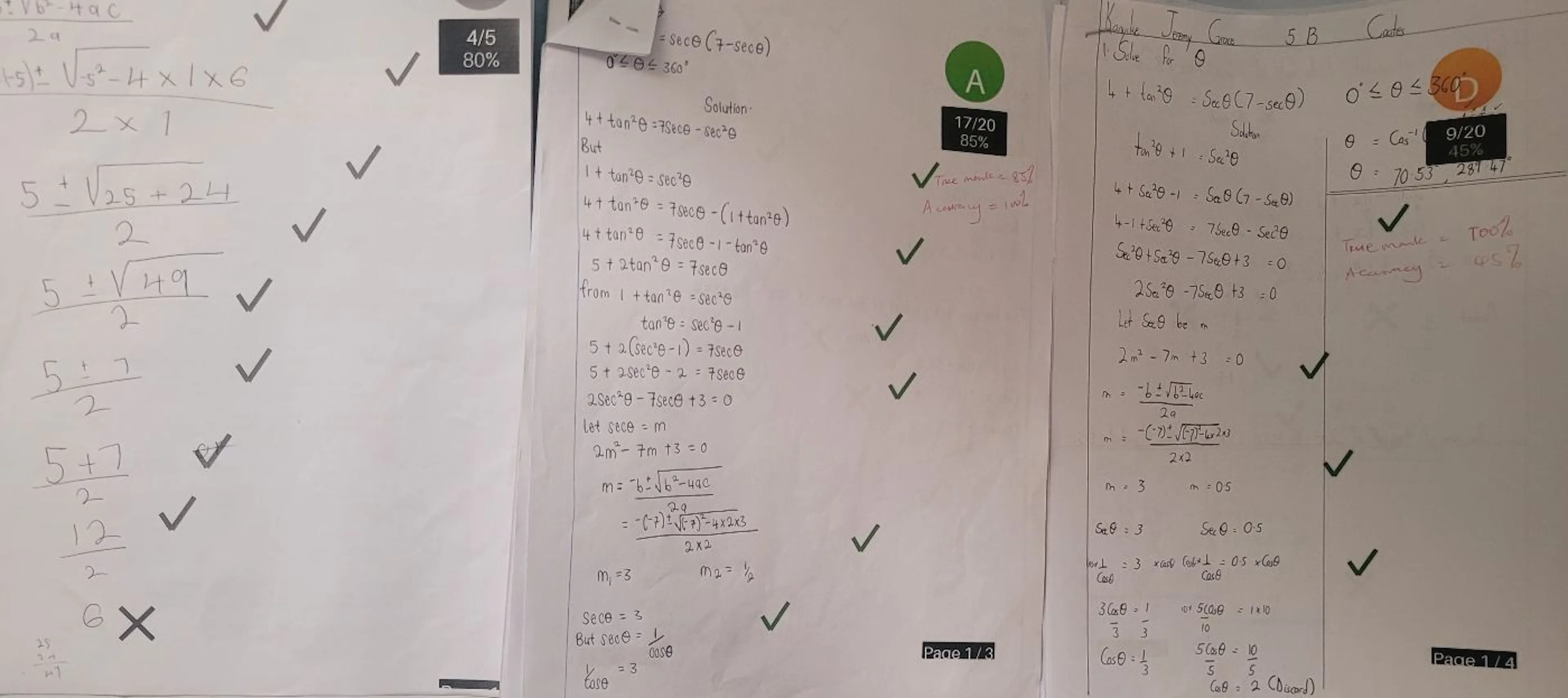 Students only see marks on a physical paper. No digital interference, no problem.
如有侵权请联系:admin#unsafe.sh