
The crypto trading world is currently buzzing about one eye-catching piece of on-chain data: smart m 2026-7-14 11:13:40 Author: hackernoon.com(查看原文) 阅读量:13 收藏
The crypto trading world is currently buzzing about one eye-catching piece of on-chain data: smart money has been recorded opening massive short positions on NVDA (Nvidia) perps on Hyperliquid, with the value reaching $13 million. What makes it even more interesting is that this position isn't just being held, but is continuously being added to — raising a big question among traders: is this the early signal of a sharp correction for AI-based stocks?
It's worth noting that Hyperliquid is indeed known as one of the crypto perpetual futures platforms that also provides perps for non-crypto assets like big tech stocks, including Nvidia. This means crypto traders can now directly "read" market sentiment toward AI stocks through on-chain positioning data, without having to rely on traditional exchange data.
Data On-Chain: Details of Smart Money Positions
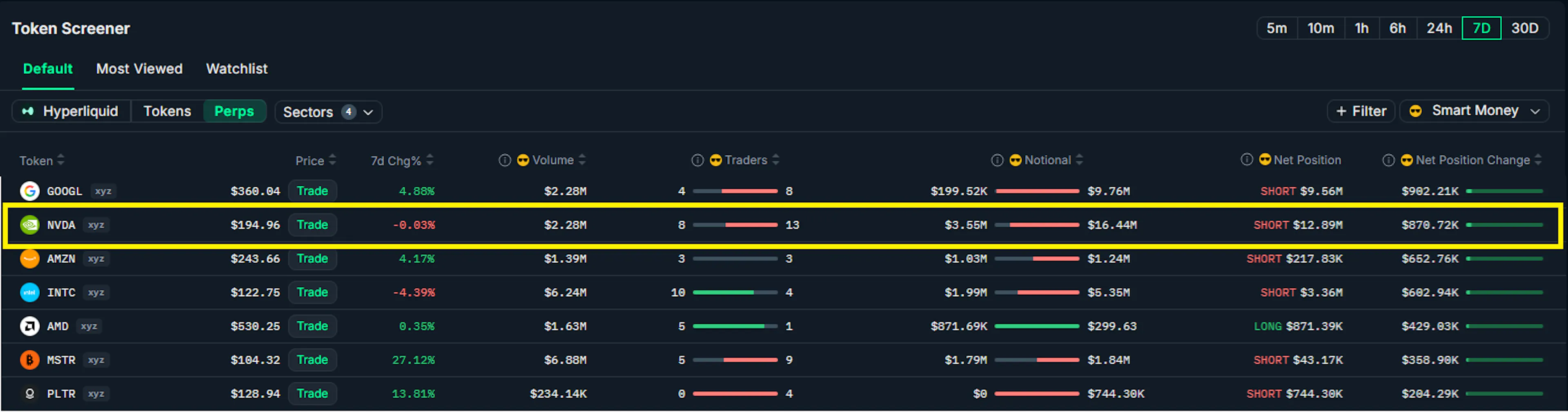 Nansen.ai: Perpetual Futures Hyperliquid 7 day
$13 Million Short Value, Big Traders Placing Bearish Bets
Based on the latest data, smart money holds a short position worth $13 million on NVDA perps on Hyperliquid. This figure makes NVDA one of the assets with the most prominent bearish pressure from the positioning side of big traders right now. A short position this large is no small number for an individual stock perp's size, and shows strong conviction from the party that opened it.
Net Position Change +$29.2K — A Signal of Adding, Not Just Holding
What makes this data even more significant is the net position change of +$29.2K. This means smart money is not just maintaining old short positions, but is actively adding to their exposure. In the trading world, adding to a position usually indicates growing conviction in the predicted direction of movement — in this case, the downward direction.
Positioning Ratio: Bearish Dominates
8 Long vs 13 Short
In terms of the number of traders, a ratio of 8 long positions to 13 short positions was recorded on NVDA perps on Hyperliquid. This ratio shows that more market participants are leaning towards the bearish side compared to bullish for this asset at the moment. Although the number of traders is not the only indicator of market strength, this ratio remains one of the commonly monitored sentiment signals.
Open Interest $153.8 Million — The Market Is Red Hot
NVDA perps open interest on Hyperliquid is recorded at $153.8 million, a relatively high figure that indicates a highly active level of trading. The larger the open interest, the greater the potential volatility if a significant price movement occurs — either through a short squeeze from the bullish side, or further weakness if short pressure becomes more dominant.
Why is Nvidia in the Spotlight?
Nvidia and the AI Bubble Narrative
Nvidia has long been known as one of the main players behind AI chip infrastructure, and its stock movement is often used as a barometer for investor sentiment toward the AI sector as a whole. Whenever there are signs of heavy selling pressure on this stock, it's only natural that the market immediately links it to the old discussion about a potential "AI bubble" — fears that the valuations of AI stocks have become too high compared to their fundamentals.
Why Crypto Traders Care About Nvidia Stock
For the crypto community, positioning data on NVDA perps serves as an alternative way to read market sentiment toward AI without having to wait for reports from traditional stock exchanges. Because platforms like Hyperliquid operate 24/7 and the data is transparently on-chain, traders can monitor sentiment changes in real-time — something that offers added value compared to the conventional stock market, which has limited trading hours.
The Arguments Behind This Narrative
The combination of short position dominance, increasing bearish exposure, and high open interest can indeed be read as a signal that some market participants are starting to anticipate a major correction in AI stocks, including Nvidia. The "AI bubble" narrative itself is nothing new — it has long been a topic of debate among both analysts and retail traders, and positioning data like this adds "ammunition" for those who are skeptical of current AI valuations.
Limitations and Risks of Reading This Signal
Even so, it is important to remember that smart money positioning can change quickly, and the long/short ratio is no absolute guarantee regarding the next price direction. This data is a snapshot of a specific moment, not a definitive prediction. Many other factors outside of on-chain data — ranging from macro sentiment, interest rate policies, to specific news related to Nvidia — can also influence the future direction of prices.
如有侵权请联系:admin#unsafe.sh