
If someone had told me five years ago that I’d be spending my Tuesday afternoons fine-tuning index p 2026-7-13 02:39:19 Author: hackernoon.com(查看原文) 阅读量:9 收藏
If someone had told me five years ago that I’d be spending my Tuesday afternoons fine-tuning index pages for Euclidean distance calculations, I would have laughed them out of the data center. Yet, here we are. The explosion of generative AI, semantic search, and hyper-personalized recommendation engines has pushed the "similarity query" from a niche academic exercise to a core business requirement.
For the longest time, DBAs had to hack their way through this problem. We were the duct-tape engineers of the data world, using unsupported CLR extensions, external vector databases, or clunky workarounds to perform Approximate Nearest Neighbor (ANN) searches. It worked, but it was never elegant, and it certainly wasn't performant at scale.
Then came native Vector Data Types and Native Indexing. For the first time, the SQL engine treats a vector not as a binary blob to be stored, but as a mathematical entity to be compared and sorted by distance. This is a paradigm shift that fundamentally changes our backup strategies, memory management, and even how we explain query performance to skeptical developers.
1. What Exactly Are We Storing? (The Technical Anatomy)
Before we talk about indexing, we need to talk about storage. In the past, if you wanted to store an embedding (say, a 1536-dimension vector from OpenAI’s text-embedding-ada-002), you had to store it as a varbinary or a nvarchar(max) and parse it on the fly. Parsing JSON or binary arrays during a query is a cardinality sin; it forces a table scan and prevents the optimizer from estimating size accurately.
With native Vector types, the engine now understands the array structure intrinsically:
- Storage Optimization: The vector is stored as a tightly packed array of single-precision floating-point numbers (
float32). - Memory Alignment: Because the engine knows the exact dimensionality, it can align these arrays in memory to leverage SIMD (Single Instruction, Multiple Data) extensions available in modern CPUs. When you run a
WHEREclause checking forDISTANCE < 0.5, the CPU isn't looping through bits; it is processing multiple dimensions per clock cycle.
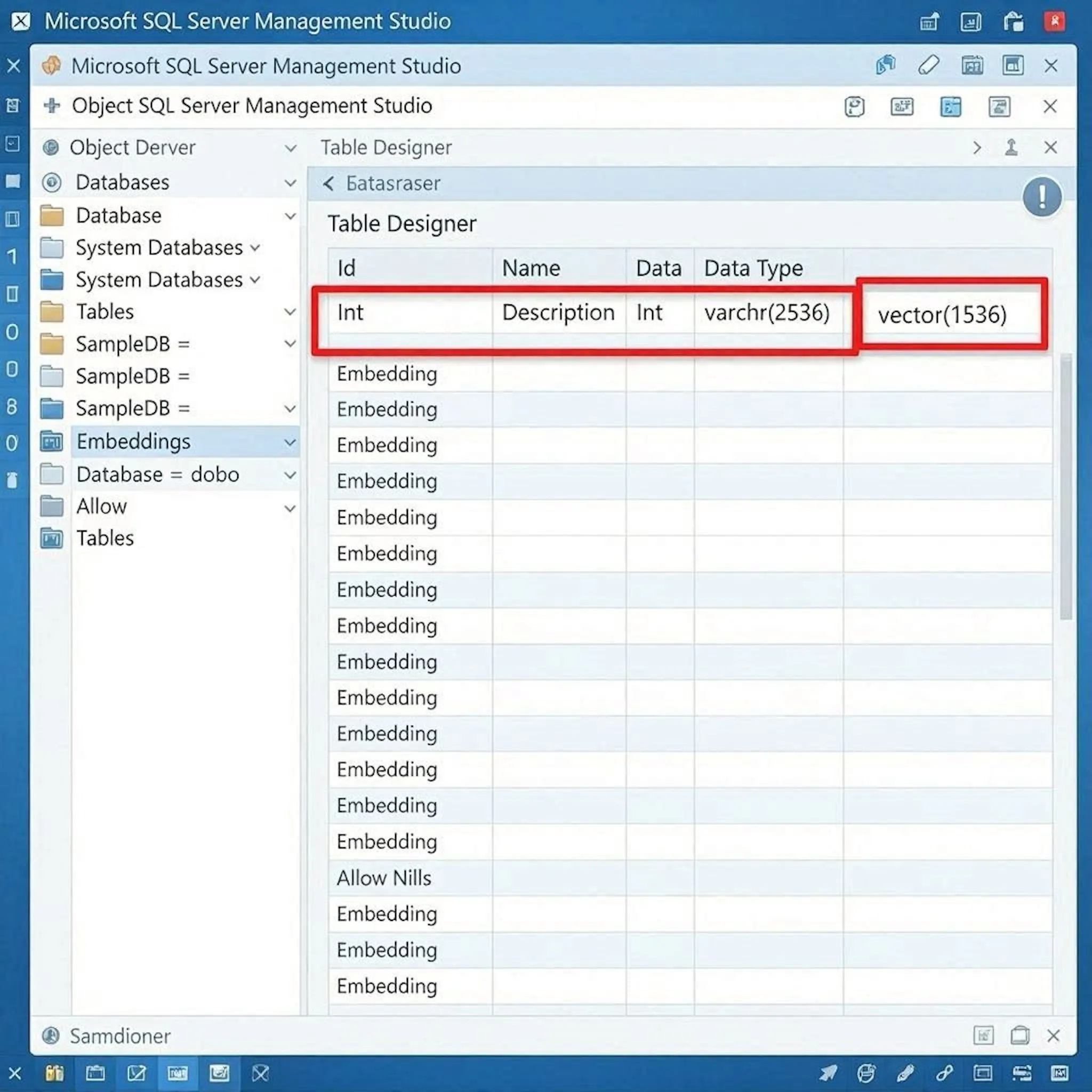 SSMS Object Explorer showing a native vector(1536) data type column definition.
2. The Shift from KNN to ANN (Why "Good Enough" Wins)
As DBAs, we are conditioned to pursue perfection. We want exact row counts, exact joins, and exact results. But in similarity searches, "exact" is your enemy.
- KNN (K-Nearest Neighbors): This performs an exact brute-force search. It compares the query vector against every single row in the table to find the top K closest matches. The complexity is O(N). For a table with 10 million records and 1536 dimensions, this query would take minutes and cripple your I/O subsystem.
- ANN (Approximate Nearest Neighbor): This sacrifices a tiny fraction of accuracy (we're talking 1% to 2% recall loss) to reduce search complexity to O(log N).
The new native indexing builds this ANN capability directly into the storage engine. It uses variations of Hierarchical Navigable Small World (HNSW) graphs or Inverted File Index (IVF). The index creates a layered graph where vector points are connected to their nearest neighbors. When you query, the engine starts at the top layer (broad strokes) and navigates down to the bottom layer (fine details) without ever touching the majority of the data pages.
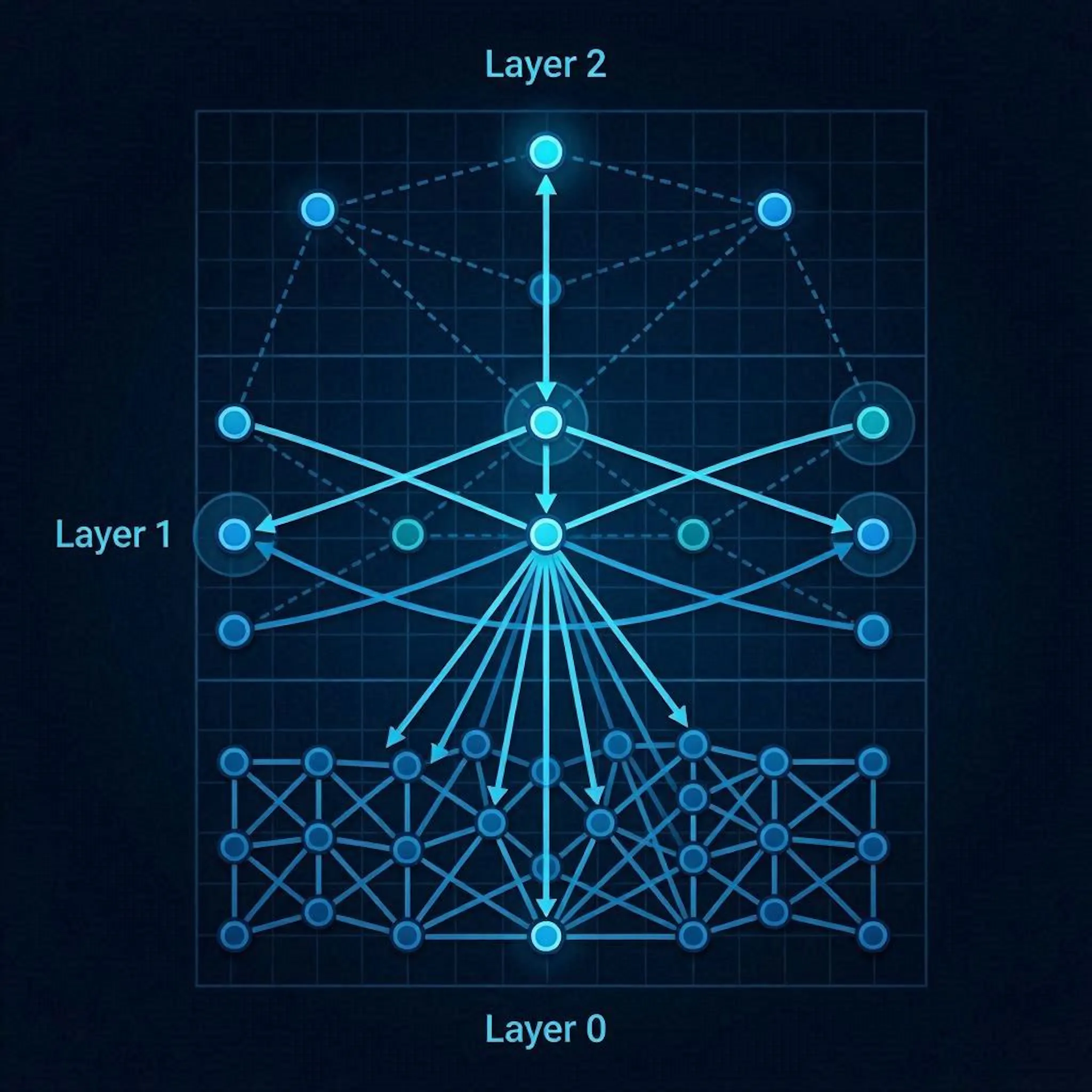 Diagram of HNSW layered graph index showing search path from top layer to bottom layer.
3. The DBA's Deep Dive: Index Maintenance & Memory
Here is where my 16 years of experience start screaming for attention. You can't just CREATE INDEX idx_vector ON dbo.Embeddings (Vector) USING ANN; and walk away. You are dealing with a mathematical structure that is highly sensitive to data distribution.
A. The Fragmentation Problem
In a B-Tree, fragmentation means more I/O reads. In an HNSW graph, fragmentation means wrong reads. As you insert new vectors, the index has to rebuild the graph connections to maintain the "small world" property. If you have high-volume inserts, the index will constantly be in a state of "churn."
My Strategy: I have moved away from "online index rebuilds" for these specific indexes. Instead, I schedule a daily maintenance window where I perform a full ALTER INDEX REBUILD. During this rebuild, the engine re-calculates the proximity graph from scratch, ensuring newly inserted vectors are optimally placed.
B. The Memory Grant Dilemma
Similarity searches are notoriously memory-intensive. The SORT operations involved in distance calculations can spill to tempdb if you aren't careful.
Critical Advice: I am now using MIN_GRANT_PERCENT hints (sparingly) for stored procedures that handle vector search. I allocate a baseline memory grant that is 20% higher than the estimated plan to avoid tempdb spills. Monitor sys.dm_exec_query_memory_grants closely—if you see RESOURCE_SEMAPHORE waits on vector queries, you need to scale up your memory.
C. Statistics Are Your New Best Friend
With high-dimensional data, standard histogram statistics (which bucketize data into ranges) are completely useless. You cannot histogram a 1536-dimension space. Consider using Full Scan for statistics updates on vector tables. A sampled statistic might miss a cluster of vectors, convincing the optimizer that a full table scan is cheaper than the index seek.
4. The Developer Experience: Code Has Never Been Simpler
This isn't just a DBA story; it simplifies the developer's life immensely. Previously, to do a semantic search, the application layer had to:
- Generate the query vector via an external API.
- Send that vector to a separate specialized vector database (like Pinecone or Milvus).
- Retrieve the IDs.
- Join back to the SQL database to get the actual metadata.
Now, with native support, the developer writes this:
|
Old Approach (External Vector DB) |
New Approach (Native SQL) |
|---|---|
|
1. Call OpenAI API |
1. Call OpenAI API |
|
2. Send vector to Pinecone |
2. |
|
3. Get IDs back from Pinecone |
3. Done. |
|
4. | |
|
Latency: ~200ms - 500ms |
Latency: ~50ms - 100ms |
sql
-- Native T-SQL Implementation
SELECT TOP 10 ProductID, ProductName,
       Vector_Distance('cosine', @QueryVector, ProductEmbedding) AS SimilarityScore
FROM dbo.Products
ORDER BY SimilarityScore ASC;
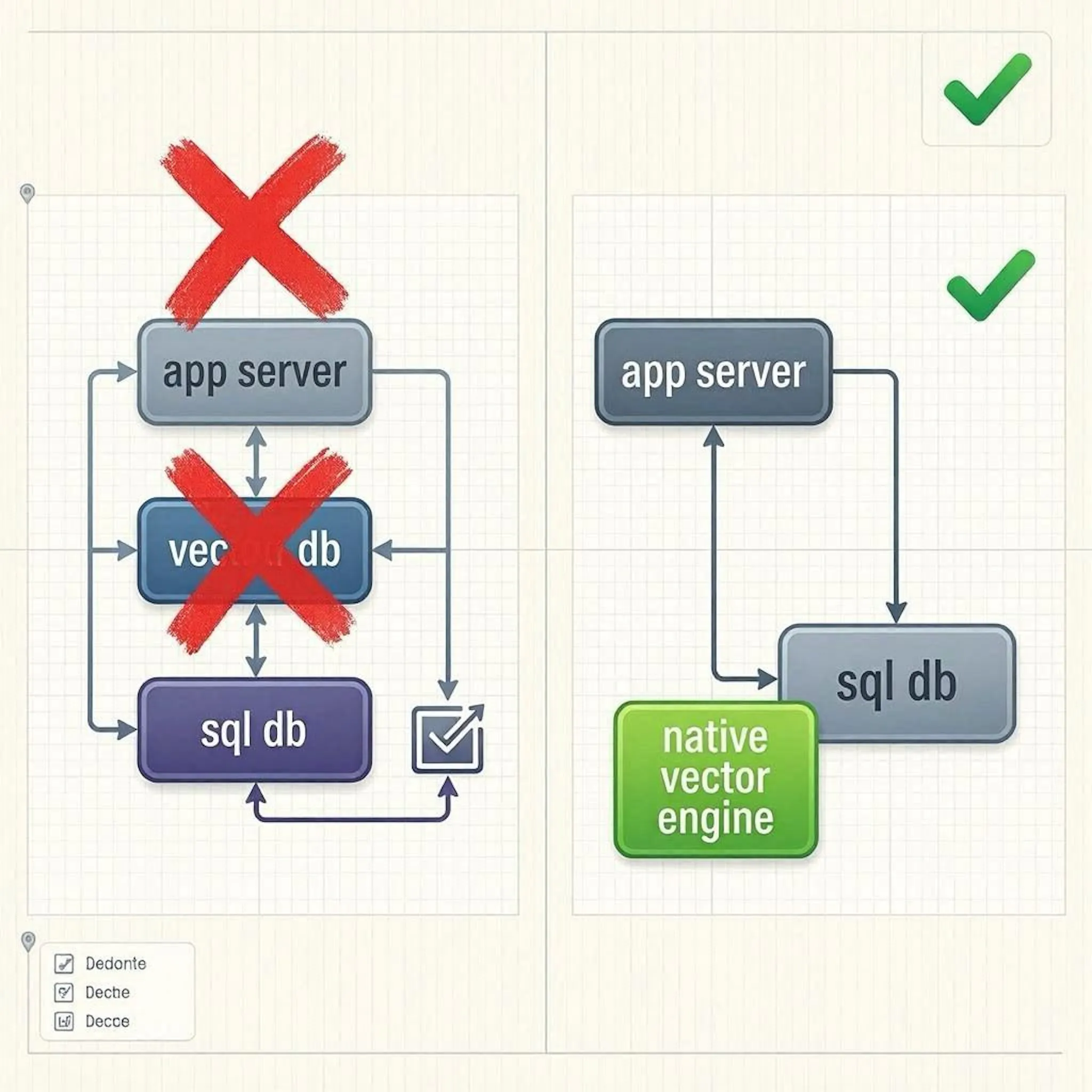 Architecture comparison showing elimination of external vector database in favor of native SQL vector support.
Let’s talk about the elephant in the room: Storage. An HNSW index is inherently "fat." For a 1536-dimension vector (approx 6KB per vector), the index itself can be 3x to 4x the size of the data.
|
Metric |
Value (1M Vectors) |
|---|---|
|
Data Size (Heap/Table) |
~6 GB |
|
HNSW Index Size |
~20 GB - 25 GB |
|
Storage Ratio |
1:4 (Data:Index) |
My Rule of Thumb: You cannot run this on a standard SSD. You need high-throughput NVMe drives. Furthermore, consider Page Compression on the heap to save ~15-20% on storage, but remember that compression adds CPU overhead during inserts.
6. Monitoring & Performance Tuning (The War Room)
When a vector search goes wrong, it goes spectacularly wrong. I recently debugged a production issue where a 2-second query ballooned to 45 seconds. The culprit? Parameter sniffing.
The first query executed with a vector that was extremely common (clustered in the center of the data space). The optimizer cached a plan that used the ANN index effectively. The second query used an "outlier" vector (far away from everyone else). Because the ANN index was optimized for approximate proximity, the outlier query had to traverse almost the entire graph.
My Solution: I introduced OPTION (RECOMPILE) for these specific vector search procedures. Additionally, I use Query Store to force the best plan if I see regressions.
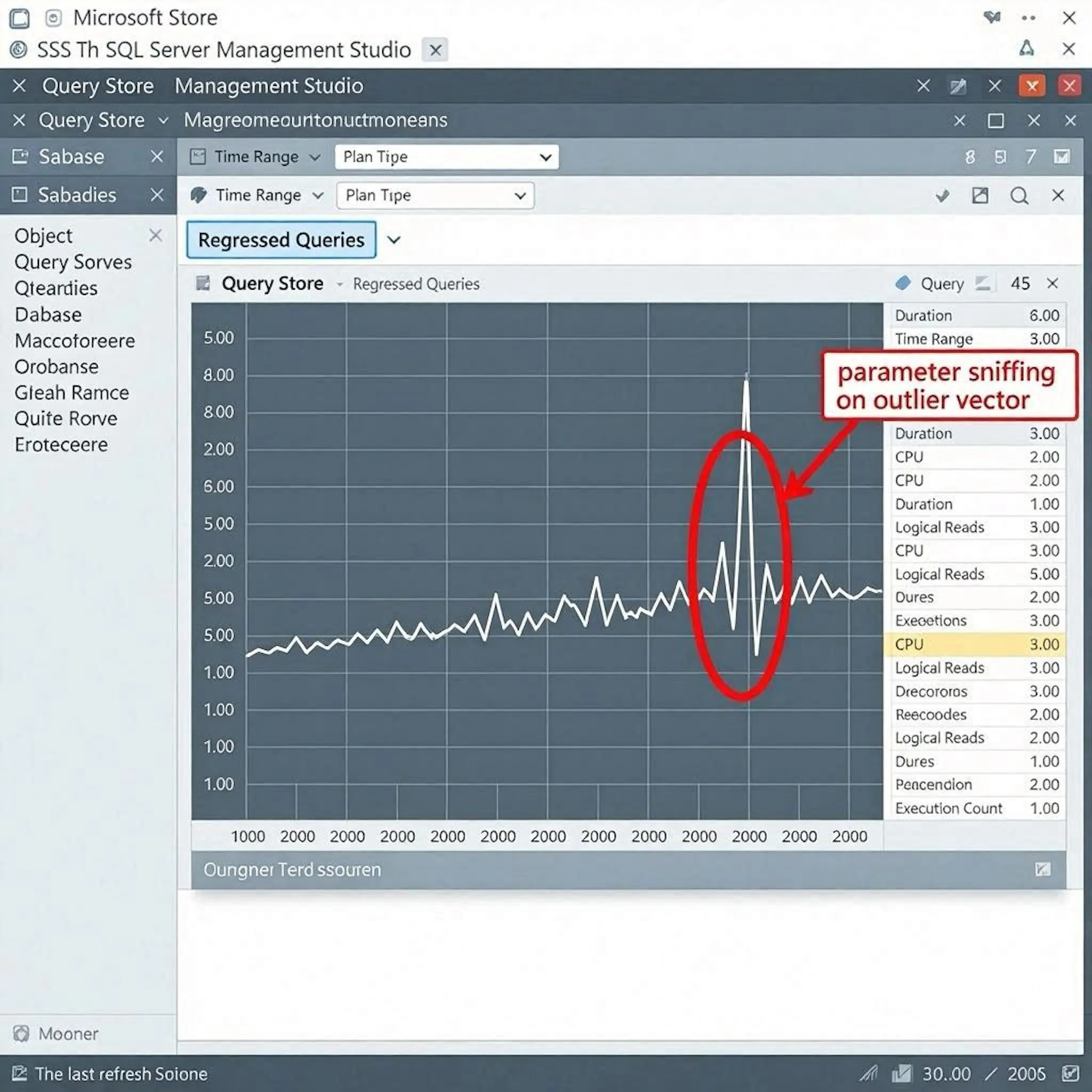 Query Store dashboard highlighting a regressed query spike caused by vector parameter sniffing
Conclusion: Embracing the Multi-Dimensional Future
The introduction of native Vector Data Types and ANN Indexing is the most significant architectural shift we've seen since the introduction of Columnstore indexes. It signals that SQL Server is no longer just a relational engine; it is becoming an AI Data Platform.
For us DBAs, this is not a threat—it is an elevation of our roles. We are managing the mathematical proximity of data. It requires us to understand concepts like dimensionality, graph traversal, and memory-aligned CPU operations. However, the fundamentals remain:
- Monitor your waits.
- Check your fragmentation.
- Respect your memory grants.
- Trust the optimizer, but verify with Query Store.
If you approach vector indexes with the same rigor you apply to clustered indexes, you will find them remarkably stable. The tools are finally in our toolbox. Now, go ahead, create that vector column, build that index, and watch your similarity queries fly.
如有侵权请联系:admin#unsafe.sh