
*The festival-to-deal pipeline is dead for 99% of creators. The audience you don’t have yet is the r 2026-7-10 03:18:23 Author: hackernoon.com(查看原文) 阅读量:18 收藏
*The festival-to-deal pipeline is dead for 99% of creators. The audience you don’t have yet is the real budget line.*
I finished a Lost Garden episode last month and did the thing every indie filmmaker has done at least once: I sat there refreshing a blank analytics page, waiting for an audience that did not exist yet. Nobody was waiting. I had spent every hour on the shots, the sound, the cut, and zero hours on the only thing that makes any of it matter, which is whether a single stranger ever sees it.
That is not a marketing problem. It is a sequencing problem, and AI just made it worse.
For a hundred years the deal was simple: you made the film, and if it was good enough, someone else’s job was to find it an audience. A programmer put it in a festival. A distributor bought it and booked it into theaters. A network scheduled it. Your job stopped at the edit. Discovery was somebody else’s department.
That deal is over for almost everyone reading this.
The pipeline that burst
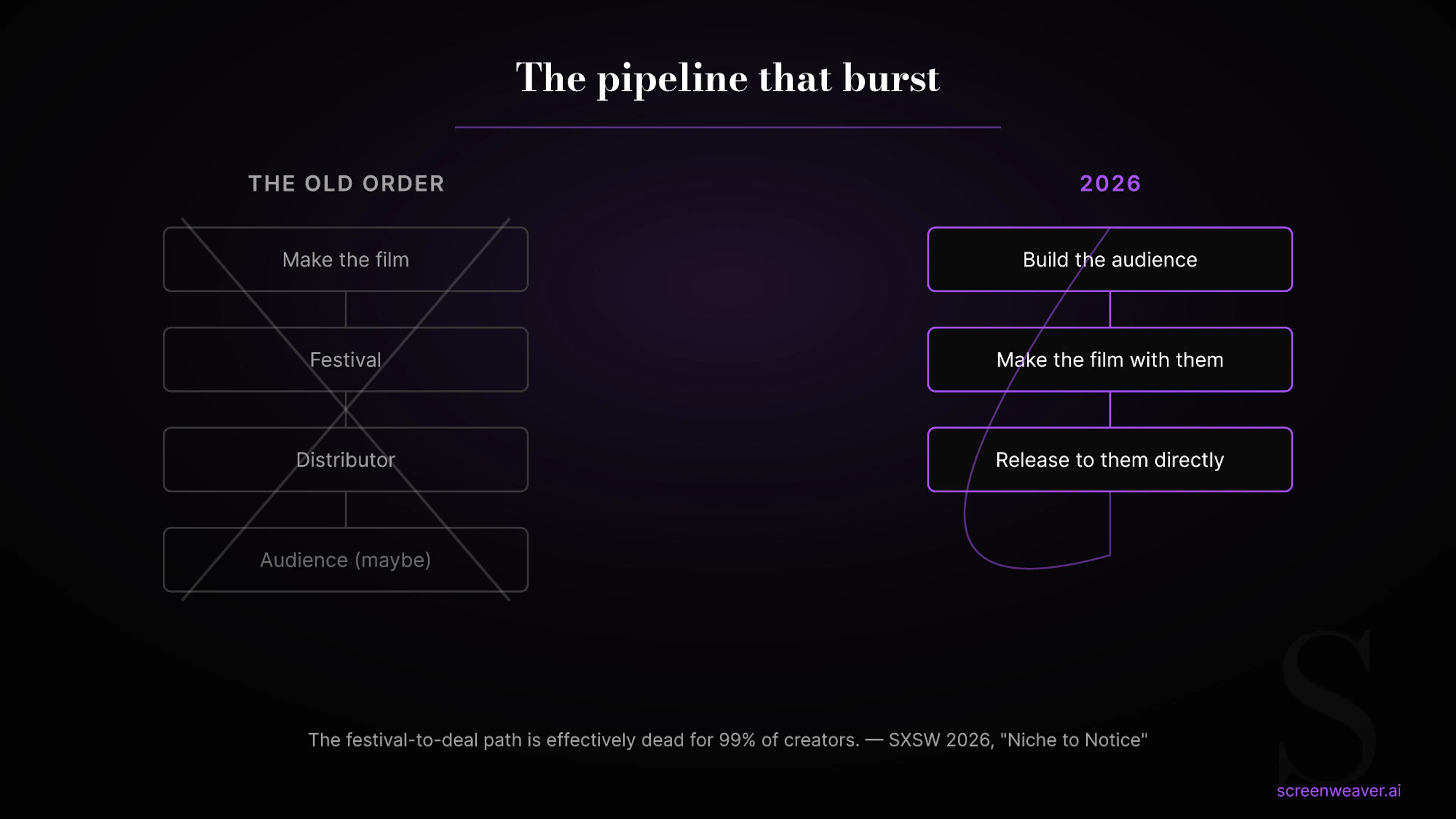
At SXSW’s 2026 “Niche to Notice” panel, industry veterans said out loud what a lot of filmmakers already suspected: the festival-to-acquisition path is effectively dead for 99 percent of creators. Not slow. Not harder than it used to be. Dead, for the overwhelming majority. No Film School reported it plainly: the traditional pipeline has “burst,” and the result is critically acclaimed films landing with no distribution deal at all, or a quiet upload to a VOD menu nobody browses.
Meanwhile festival attendance is not dying. Eventive’s whitepaper analyzed more than 15 million ticket sales across roughly 6,000 festival editions and found audiences are still showing up in person. The festivals aren’t disappearing. What’s disappearing is the idea that getting into one is a distribution strategy rather than a nice credential.
So if the old finish line moved, or vanished, what replaced it?
The traditional pipeline has burst, often leaving critically acclaimed films with no distribution deal or a quiet upload to an obscure VOD menu.
The 50/50 rule nobody budgets for
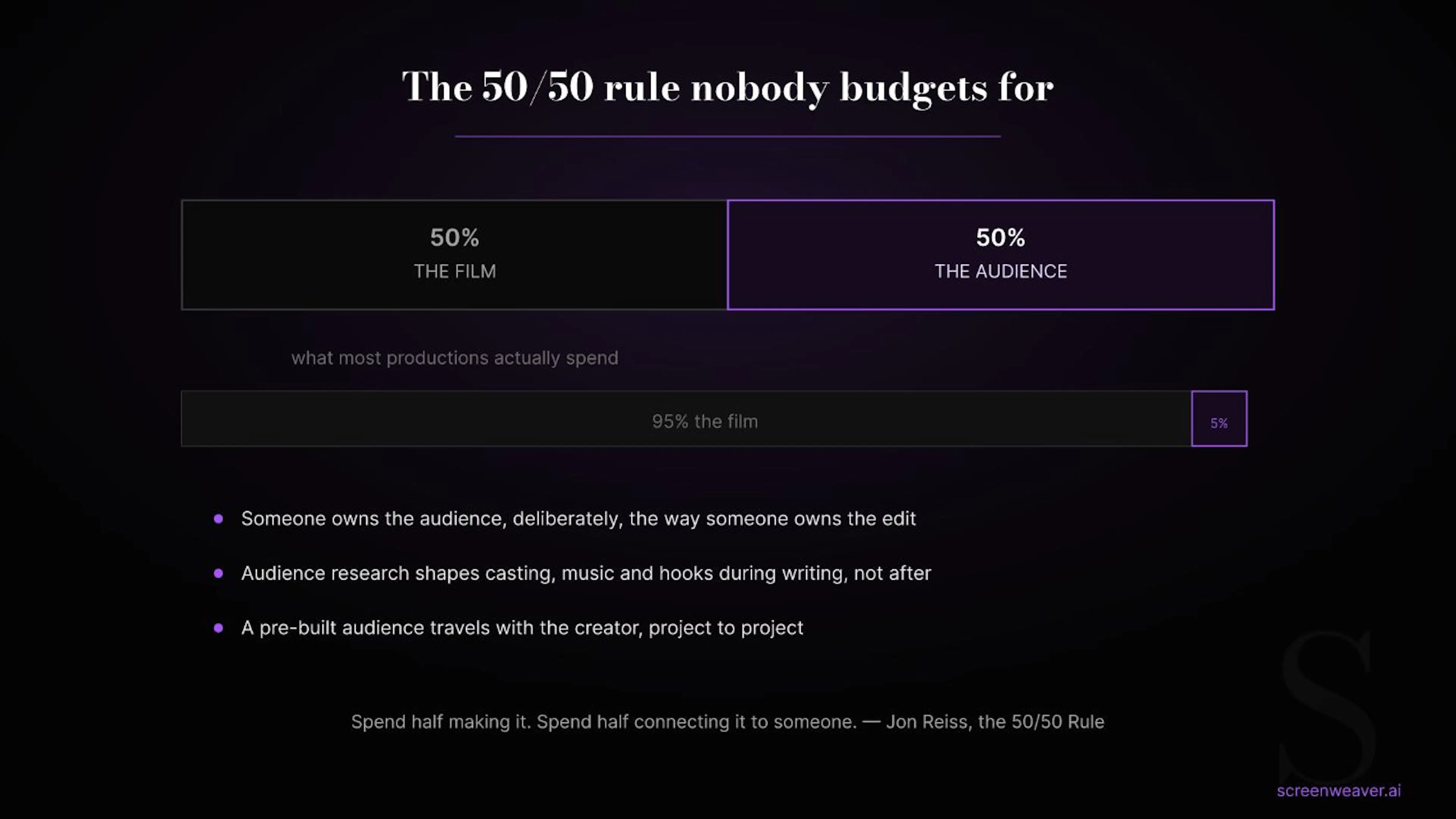
Producer and author Jon Reiss has been arguing for years for what’s now called the 50/50 Rule: spend half your resources making the film, and half connecting that film to an actual audience. Not half the afterthought. Half the budget, the time, the attention you give the project, full stop.
Almost nobody does this. I didn’t, on that Lost Garden episode. Most indie productions spend 95 percent of everything on the thing and 5 percent, usually a rushed week before release, on whether anyone will see the thing. Then they’re confused when it lands with a thud.
Here’s what the 50/50 split actually asks of you, according to the people doing it seriously in 2026:
- Someone owns audience the way someone owns the edit. Increasingly that’s a specific role, a Producer of Marketing and Distribution, or you, wearing that hat deliberately instead of by accident.
- Audience research happens during writing, not after the premiere. Casting, music, hooks, even structure get shaped by who you’re making this for, decided early enough to still change something.
- A pre-built audience travels with the creator, not the project. A newsletter, a following, a community that already trusts your taste is worth more on release day than a festival laurel, because it’s the difference between a quiet upload and people actually waiting.
That last point is the one that stings, because it means the work doesn’t start at the premiere. It starts months, sometimes years, before the film exists.
Algorithms don’t wait for festivals either
The other half of this shift is mechanical, not philosophical. TikTok’s For You feed, YouTube Shorts, and Instagram Reels each run their own machine-learned ranking on completely unknown creators, tracking watch time, completion rate, rewatch behavior, comments, shares. No gatekeeper reviews your reel before it can reach a million people. No festival programmer stands between a fifteen-second clip and the algorithm deciding it’s worth showing to the next thousand viewers.
That’s a real door that didn’t used to exist. It’s also, and this is the part people skip, a door that opens on volume. The algorithm rewards constant testing: different cuts, different hooks, different thumbnails, watching what a specific slice of strangers actually finishes versus scrolls past. It is a full second production discipline, running in parallel with the film itself, and it eats exactly the hours the 50/50 rule says you owe it.
AI made this harder, not easier
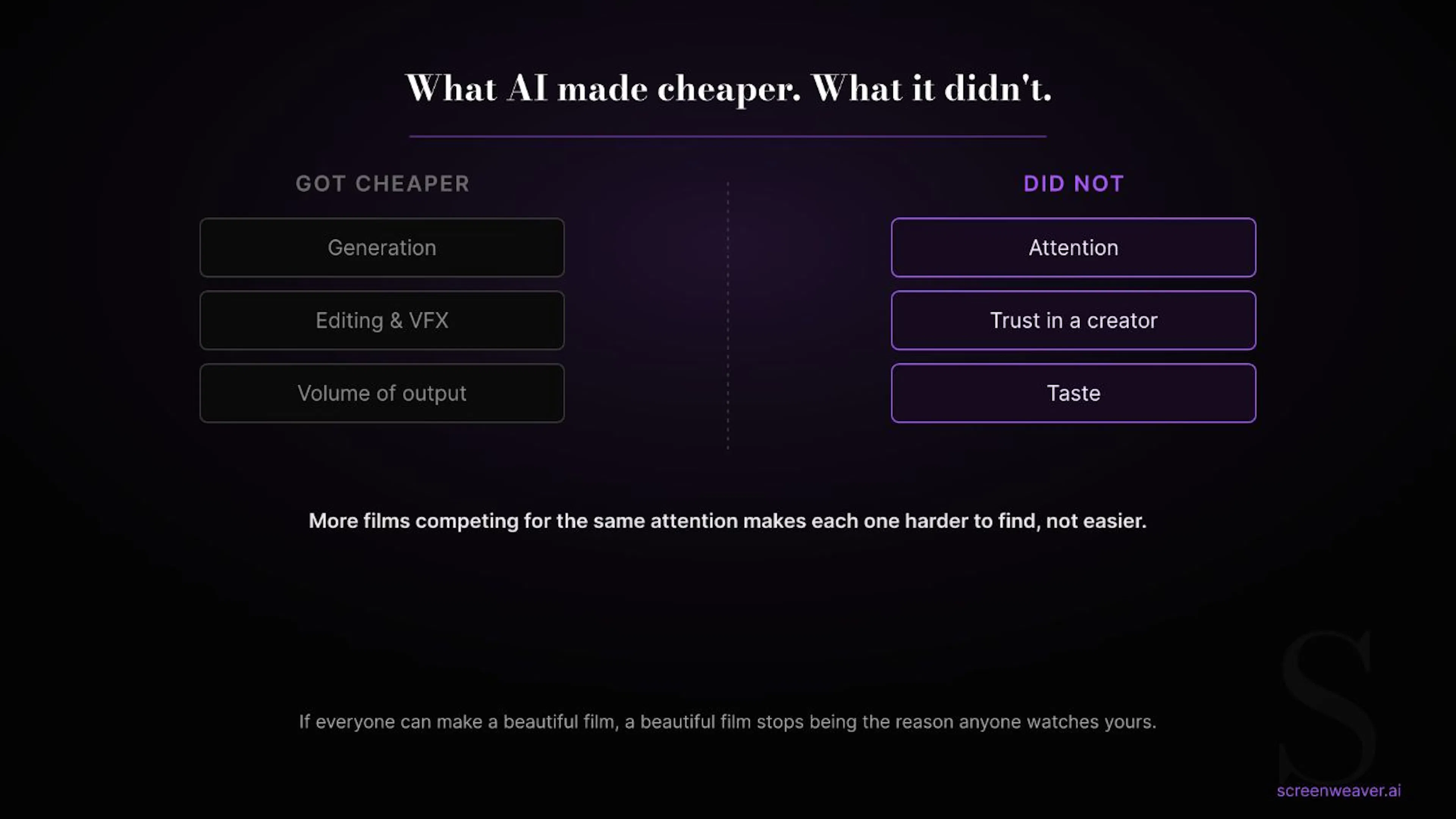
Here’s the part that should worry anyone treating generative tools as a shortcut to an audience. When a short film costs fifty dollars and a weekend instead of fifty thousand dollars and a crew, more people make one. A lot more people. The scarce resource was never really the camera. It was always attention, and attention did not get cheaper just because generation did. If anything, a flood of technically competent, visually striking AI shorts makes a stranger’s fifteen seconds of attention more expensive to earn, not less, because there is more of everything competing for the same feed.
I feel this building Lost Garden. The generation side got dramatically cheaper over the last year. Finding the handful of people who’d actually care about a dark-fantasy anime series made by one person did not get cheaper at all. If anything it got harder, because the bar for “looks professional” stopped being a filter. Anyone can clear it now.
If everyone can make a beautiful film, a beautiful film stops being the reason anyone watches yours.

Treating distribution as pre-production, not a chore
The practical shift, the one I’m actually trying to run on now, looks less like marketing and more like production planning:
- Decide who this is for before you generate a single shot, not after the cut is locked. The audience is a creative constraint like budget or runtime, not a task for the week of release.
- Build the smallest real audience you can before the film is finished. Even a hundred people who’ve seen behind-the-scenes work and already have opinions about your characters are worth more than a cold premiere to zero.
- Define success before you need the answer. Reiss’s panel called this a “North Star”: are you chasing revenue, or Return on Impact, or Return on Experience that builds your next project’s audience? Each answer changes what you should spend the next month doing.
- Keep the audience thinking attached to the plan, not scattered across a dozen tools you’ll forget existed by release week. This is the unglamorous half of the job, and it’s the half most likely to fall through the cracks between writing, generation, and cut.
That last point is exactly the gap I built ScreenWeaver to close for my own work: the plan, the audience notes, the “who is this for and why” sitting next to the script and the shot list instead of living in someone’s head until it’s too late to act on it.
The uncomfortable part
None of this makes distribution easy. If anything, the job got bigger. Generation used to be the hard, expensive, gatekept half of making a film, and now it mostly isn’t. The audience-building half was always there, quietly, underneath the glamour of “getting into a festival,” and now it’s the whole job for most of us, because nobody is coming to hand you an audience anymore.
I’d rather know that going in than find out refreshing a blank analytics page after the film is already done.
如有侵权请联系:admin#unsafe.sh