The Emerging Offensive Landscape Around Enterprise AI ProliferationThe rapid proliferation of 2026-5-14 19:16:21 Author: krypt3ia.wordpress.com(查看原文) 阅读量:36 收藏
The Emerging Offensive Landscape Around Enterprise AI Proliferation

The rapid proliferation of enterprise AI systems between 2025 and 2026 has fundamentally altered the cyber threat landscape. Artificial intelligence is no longer confined to isolated research environments or experimental productivity tooling. Large language models, retrieval-augmented generation platforms, AI agents, developer copilots, autonomous workflow systems, and AI-enabled analytics are now deeply integrated into enterprise operations, cloud infrastructure, software development pipelines, security operations centers, customer-service ecosystems, legal review processes, and executive decision-making environments.
This integration has transformed AI systems into high-value operational infrastructure. As a result, advanced persistent threat actors are increasingly shifting from merely using AI as an operational aid toward directly targeting AI systems themselves.
The strategic significance of this transition is substantial. AI systems increasingly function as privileged intermediaries between users, data, infrastructure, and action. They ingest sensitive information, summarize classified or proprietary material, query internal databases, automate workflows, interact with APIs, generate code, and in some cases execute tasks autonomously through agentic frameworks. This makes them attractive not simply as data sources, but as operational amplifiers capable of extending adversary reach across enterprise ecosystems.
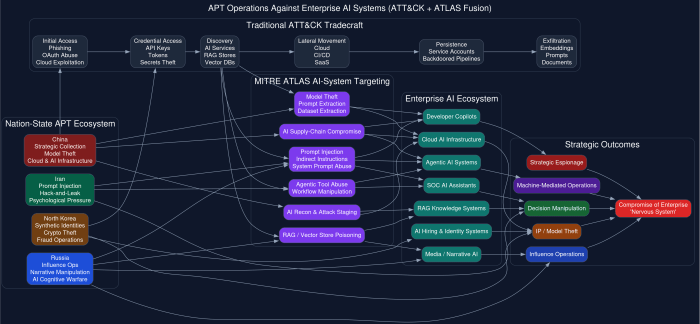
MITRE ATT&CK remains useful for modeling the traditional phases of compromise surrounding these environments, including initial access, credential theft, cloud exploitation, lateral movement, persistence, and exfiltration. MITRE ATLAS extends this understanding into AI-specific adversarial behavior by modeling attacks directed at models, prompts, retrieval systems, datasets, orchestration layers, and autonomous agents themselves. Together, the two frameworks illustrate the emergence of a dual-layer attack model in which conventional cyber intrusion methods are increasingly combined with AI-specific exploitation techniques.
The most important strategic reality emerging from this evolution is that AI systems are becoming “soft privileged infrastructure.” They frequently possess broad contextual awareness, access to sensitive internal knowledge, delegated authority, and trusted positioning inside enterprise workflows. In many organizations, AI systems already possess visibility and operational reach comparable to highly privileged human employees, yet they often lack equivalent security boundaries, segmentation, behavioral controls, or audit maturity.
This creates a new category of attack surface for nation-state actors.
Chinese cyber operations are likely to represent the most sophisticated long-term threat to proliferating AI ecosystems. Chinese intelligence doctrine has historically emphasized strategic collection, intellectual property acquisition, telecommunications compromise, cloud infrastructure access, and long-duration persistence inside critical sectors. AI systems directly intersect with all of these objectives. Public reporting from 2025 and 2026 showed Chinese-linked operators using generative AI throughout operational workflows, including reconnaissance, vulnerability research, code generation, cloud operations support, and influence campaigns. More importantly, these actors increasingly demonstrated behaviors consistent with preparation for targeting AI-enabled infrastructure itself.
For Chinese operations, enterprise AI systems represent centralized repositories of organizational knowledge and operational logic. A compromised AI assistant connected to research repositories, internal documents, cloud infrastructure, engineering pipelines, or telecommunications environments could provide enormous intelligence value. Chinese APT actors are therefore likely to prioritize theft of model weights, fine-tuning datasets, system prompts, orchestration logic, retrieval corpora, and embedded enterprise knowledge systems. Compromise of AI-enabled software development environments is also likely to become a priority because AI-assisted developer tooling increasingly touches source code, CI/CD infrastructure, cloud APIs, and deployment pipelines simultaneously.
Russia’s operational focus is likely to differ significantly. Russian cyber doctrine has long emphasized information confrontation, psychological operations, strategic ambiguity, and manipulation of cognitive environments. AI systems provide an ideal platform for these objectives. Rather than primarily targeting AI for industrial espionage or intellectual property acquisition, Russian operations are more likely to focus on manipulation of AI-driven decision-making, media analysis, narrative generation, and information ecosystems.
As enterprises, governments, and media organizations increasingly rely on AI for summarization, analytics, monitoring, and information synthesis, the integrity of those systems becomes strategically important. Russian actors are therefore likely to pursue poisoning operations against retrieval systems, influence datasets, media-monitoring pipelines, and AI-assisted analytic environments. A manipulated AI system does not necessarily need to provide overtly false information to achieve strategic effect. Subtle framing shifts, selective omissions, confidence manipulation, or narrative weighting changes could gradually distort analytic outputs and decision-making processes at scale.
Russian influence operations already demonstrated increasing use of AI-generated media, synthetic personas, automated engagement, multilingual content generation, and coordinated narrative amplification during 2025 and 2026. The next logical progression is direct targeting of the AI systems used to identify, analyze, or respond to those influence operations.
Iranian cyber operations are likely to integrate AI-system targeting into the broader convergence already visible across Iranian espionage, influence operations, ransomware aesthetics, psychological pressure campaigns, and hack-and-leak ecosystems. Iranian operations historically emphasize ambiguity and cognitive impact as much as technical sophistication. AI systems offer an attractive mechanism for amplifying these effects.
Iranian actors are particularly likely to exploit prompt injection and retrieval poisoning opportunities inside enterprise environments. The growing adoption of retrieval-augmented generation architectures creates an especially dangerous attack surface because many organizations now allow AI systems to ingest large volumes of semi-trusted or externally sourced content. If adversaries can insert malicious instructions into documents later processed by AI systems, they may be able to manipulate model behavior indirectly. This technique effectively turns ordinary documents, emails, PDFs, tickets, or web content into operational payloads.
The strategic danger is magnified when AI systems possess delegated authority. A compromised or manipulated enterprise AI agent may not merely generate incorrect text. It may retrieve sensitive documents, expose internal information, alter workflows, generate malicious code, trigger actions, or influence human decisions while appearing trustworthy. Iranian operations focused on psychological manipulation and ambiguity could exploit such environments effectively because the line between human judgment and machine-generated output becomes increasingly blurred.
North Korean operations are likely to focus on financially valuable AI ecosystems and identity-centric AI workflows. DPRK cyber activity has consistently emphasized cryptocurrency theft, remote employment fraud, synthetic identity operations, and operational scalability through deception. AI systems directly enhance all of these capabilities.
North Korean actors already demonstrated operational use of AI-generated resumes, interview support, synthetic personas, recruiter lures, and phishing content during 2025. As enterprises increasingly deploy AI-assisted hiring, coding assessment, and remote workforce validation systems, those systems themselves become attractive targets. North Korean operators are likely to attempt manipulation of AI-driven recruiting workflows, developer-assistance platforms, fraud-detection systems, and financial AI models to support access generation and cryptocurrency theft operations.
One of the most immediate technical threats emerging across all actor classes is prompt injection. Prompt injection represents the AI-era equivalent of social engineering against a machine intermediary. The most dangerous form is indirect prompt injection, in which hostile instructions are embedded into content later processed by an AI system. Because many enterprise AI systems now summarize documents, analyze support tickets, review emails, process chat messages, or ingest web content automatically, malicious instructions can propagate through normal business workflows without obvious signs of compromise.
This is operationally significant because AI systems increasingly bridge trust boundaries. A compromised AI assistant may possess access to internal repositories, ticketing systems, email systems, developer environments, or cloud tooling. If manipulated successfully, the AI effectively becomes an insider acting on behalf of the adversary.
Retrieval-augmented generation systems create another critical attack surface. These systems rely on external or internal document stores to provide contextual information to models during inference. If adversaries can poison the retrieval corpus, they may influence what the model believes is authoritative. Over time, poisoned retrieval environments could manipulate security operations, legal analysis, intelligence production, policy recommendations, or software-development guidance without requiring direct compromise of the underlying model.
Model theft and system-prompt extraction are also likely to become increasingly important intelligence objectives. Fine-tuned enterprise models may encode proprietary workflows, internal operational logic, strategic research, or highly sensitive institutional knowledge. Theft of these systems would provide both economic and intelligence value. Similarly, extraction of hidden system prompts may reveal escalation rules, filtering logic, operational boundaries, or internal governance procedures that adversaries can later exploit.
The AI supply chain itself is emerging as a major strategic vulnerability. Modern AI ecosystems depend on models, embeddings, plugins, orchestration frameworks, vector databases, notebooks, training datasets, evaluation pipelines, and third-party tooling. This supply chain is considerably broader and less mature than traditional software supply chains. Compromise of a single model artifact, orchestration component, plugin, or dataset could propagate malicious behavior into large numbers of downstream environments.
The rise of agentic AI systems further magnifies the threat landscape. Traditional chatbots primarily generate information. Agentic systems increasingly perform actions. They can query databases, access repositories, send emails, modify tickets, execute workflows, update cloud resources, or interact with external APIs autonomously. Once AI systems gain the ability to act rather than merely respond, compromise of those systems becomes operationally equivalent to compromise of a privileged internal operator.
The security implications are profound. AI systems can no longer be treated as simple productivity tools. They increasingly function as distributed identity and automation layers embedded throughout enterprise infrastructure. This means AI security is simultaneously:
- a cloud-security problem,
- an identity-security problem,
- a supply-chain-security problem,
- a counterintelligence problem,
- a software-assurance problem,
- and an information-warfare problem.
The likely future trajectory is not immediate autonomous AI cyberwarfare. Rather, it is the gradual operational convergence of conventional intrusion tradecraft, AI-enabled operational acceleration, AI-system targeting, and machine-mediated influence operations into unified strategic campaigns.
The most dangerous future scenario is not merely an APT actor using AI to write malware. It is an adversary compromising an enterprise AI system that already possesses access to organizational memory, internal trust relationships, cloud infrastructure, sensitive documents, developer workflows, and decision-support mechanisms.
In that environment, compromise of the AI layer effectively becomes compromise of the enterprise nervous system itself.
Primary Frameworks and Standards
- MITRE ATLAS MITRE Adversarial Threat Landscape for Artificial-Intelligence Systems (ATLAS). Framework for modeling adversarial tactics, techniques, and procedures targeting AI-enabled systems.
- MITRE ATT&CK Framework MITRE ATT&CK knowledge base for adversary tactics and techniques across enterprise, cloud, mobile, and ICS environments.
- NIST AI Risk Management Framework (AI RMF) National Institute of Standards and Technology framework for identifying and mitigating AI-related risks.
- NIST Generative AI Profile NIST guidance focused specifically on generative AI operational and security risk.
- OWASP Top 10 for LLM Applications Open Worldwide Application Security Project guidance covering prompt injection, data poisoning, insecure output handling, excessive agency, and AI supply-chain vulnerabilities.
- OWASP GenAI Security Project OWASP project tracking emerging security risks in generative AI systems and deployments.
Threat Intelligence and Vendor Reporting
- Google Threat Intelligence Group – Adversarial Misuse of Generative AI Analysis of nation-state and cybercriminal use of generative AI for reconnaissance, malware development, phishing, vulnerability research, and operational support.
- Google Cloud Blog – AI, Vulnerability Exploitation, and Initial Access Operations Reporting on AI-assisted vulnerability exploitation, augmented intrusion operations, and operational acceleration by threat actors.
- Google Cloud Blog – Distillation, Experimentation, and AI Adversarial Use Discussion of model extraction, distillation, and adversarial experimentation involving AI systems.
- OpenAI – Disrupting Malicious Uses of AI (June 2025) Threat intelligence report documenting state-linked and criminal abuse of generative AI systems.
- OpenAI – Disrupting Malicious Uses of AI (October 2025) Follow-on analysis of operationalized AI use in cyber operations, influence campaigns, and deceptive identity activity.
- Anthropic – Disrupting AI-Enabled Espionage Campaigns Reporting on China-linked actor GTG-1002 and use of agentic AI capabilities during cyber-espionage operations.
- Microsoft Digital Defense Report 2025 Microsoft analysis of nation-state cyber operations, AI-assisted influence campaigns, and evolving cyber threat trends.
AI Security Research and Technical Analysis
- TechRadar – Second-Order Prompt Injection Can Turn AI Into a Malicious Insider Coverage of indirect prompt injection risks and enterprise AI workflow manipulation.
- Reuters – Hackers Pushing Innovation in AI-Enabled Hacking Operations, Google Says Reuters reporting on Google’s assessment of AI-assisted vulnerability discovery and exploit development.
- OWASP LLM01: Prompt Injection Technical overview of direct and indirect prompt injection risks against LLM systems.
- OWASP LLM03: Training Data Poisoning Analysis of poisoning attacks against AI training and retrieval ecosystems.
- OWASP LLM08: Excessive Agency Technical discussion of autonomous tool invocation and agentic AI risk.
Strategic and Policy Context
- CISA Artificial Intelligence Resources U.S. Cybersecurity and Infrastructure Security Agency AI security guidance and operational advisories.
- ENISA – Artificial Intelligence Threat Landscape European Union Agency for Cybersecurity threat assessment for AI ecosystems.
- Center for Security and Emerging Technology (CSET) Research on AI security, geopolitical competition, and national-security implications of AI systems.
- RAND Corporation – Securing Artificial Intelligence Systems RAND analysis of AI operational security, adversarial ML, and strategic cyber implications.
- Atlantic Council Cyber Statecraft Initiative Strategic analysis of AI-enabled cyber conflict, state behavior, and information operations.
如有侵权请联系:admin#unsafe.sh